




Forestry Photo Gallery
|
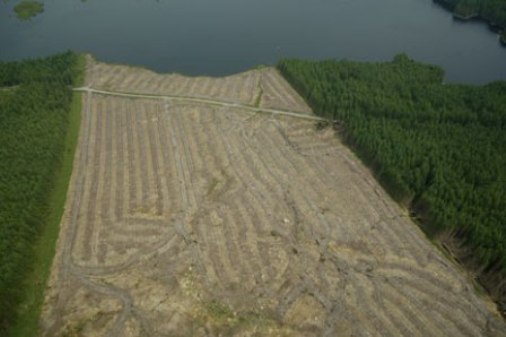
This photograph is of the clearfell that is alleged to have led in 2004 to one of the worst fresh water pearl mussel kills in Ireland. The forestry reaching clearfell now in Ireland's uplands was planted before there was today's undertanding of the sensitivity of this ecology. Records shows that more than 1500 kilos of rock phosphate per hectare was applied during the 40 year rotation on this remote site at the headland of the Owenriff River system in the west of Ireland. A Forest Service email about this site said 'Having looked at the Owenriff situation it is my impression that we are sitting on fertiliser timebombs (pardon pun) that are now coming to the fore after 50+ years of fertiliser usage for forestry.' |
|
Clearfelling is being undertaken throughout Ireland at a rate of 10,000 hectares a year. Often the sites are hidden from the public. Rosnacroo, near the Millenium Forest at Kilgarvin, County Kerry. |
|
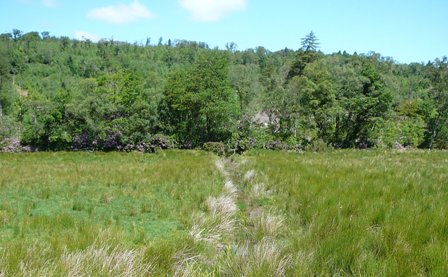
This photograph shows a brash harvesting track from the Forest Service Forestry and Water Quality Guidelines. This is given as in need of renewal. Look what actually happens. |
|
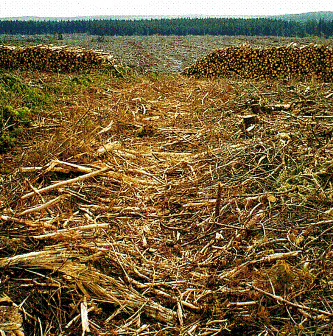
In fact, inside these sites battlefield conditions exist where heavy machinery causes irreparable damage to soils. At this site in Rosnacroo, Coillte informed FIE that 'the Forest Service have confirmed, having visited and inspected the site in question, that Coillte operated within Forest Service Guidelines with regard to all aspects on this site.' |
|
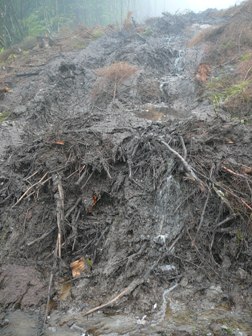
More than any other, this photograph captures the total disregard for the environment shown in clearfelling on these soils. In this case, Coillte Teo claimed that 'there is clear evidence of brash mats being used on all the extraction racks and the main track.' Large raindrops fall to the earth at 30 km per hour, displacing soil particles as far as 2 metres. Rosnacroo, Co. Kerry. |

|
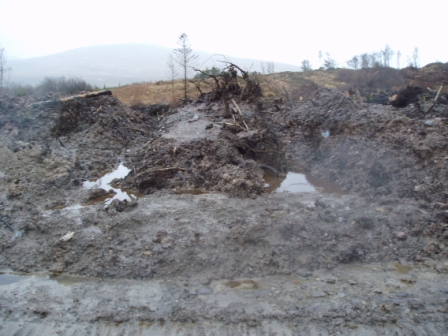
In this typical photograph heavy machinery has entirely destroyed the structure of the soil. Rutting is irreversible soil damage. The Forest Stewardship Council's [FSC] auditors refused to accept photographic evidence of environmental damage, telling FIE that 'photographs are too hard to interpret'. Gour, Castletownbere. |
|
Above the water supply for Sneem, Co. Kerry, a mountain stream runs along the site edge here under the bluff on the right. The Guidelines state: Do not allow branches, logs, or debris to build up in aquatic zones. All such material should be removed when harvesting operations have been completed. This site had been harvested, restored, and planted before this photograph. Residents here told Coillte that the site was flooding sediment and brash onto their lands. The Environmental Impact Assessment for this site records a meeting at which Coillte said that their issues can not be resolved by Coillte due to our Forestry and Water Guidelines prohibiting us from opening streams and potentially silting water courses. Although not mentioned in the Coillte EIA Checklist, the EPA Sampling Station at Ardsheelhane had noted forestry logging in progress, observing that 'Because of filamentous algal growth' the 'pearl mussel population at the lowermost location are now to be found chiefly at the shaded margins of the river, which can lead to desiccation in low flows.' |
|
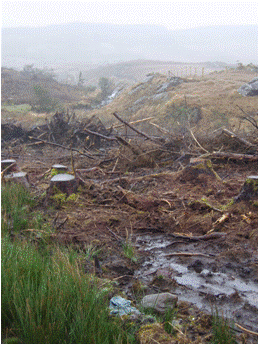
More rutting at the Gour, Castletownbere site during 'restoration' of the site. The soil is freely draining shallow peat soil with occasional bare rock outcrops on slopes. Deeper peat soils are present in poorly drained pockets and where the slope decreases. These soils are categorised as highly vulnerable to erosion. Even the economic value of felling these remote sites is unproven as Coillte does not do an economic analysis on a site by site basis. |
|
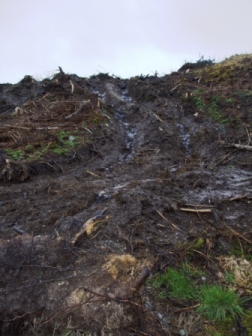
Attempts to control erosion are not possible on the steep fragile soils of the west under normal flood conditions. The use of straw bales continues in spite of the obvious futility to conform with Government Forestry Guidelines. An email from a Forest Service official in 2004 noted during the fresh water pearl mussel controversy site in the first photograph, 'When we inspected traps (straw bales) in the forestry at the head of Owenriff system we found that water was freely flowing over the bales which were not having any effect whatsoever in filtering the nutrient loaded water going into the lake. Coillte staff present thought nothing of this and assumed that they had done a good job with the bales.' Gour, Castletownbere. |

|
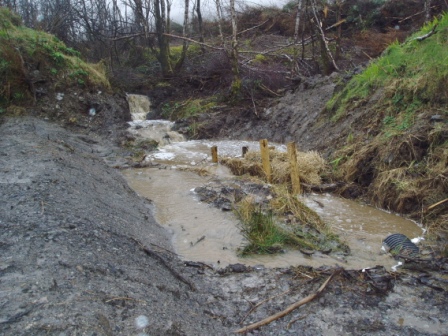
A good example of the futility of straw bales as silt traps on these sites in the West of Ireland. They have no impact on the flow of sediment from the clearfell sites during heavy rainfalls, which are increasing in frequency and intensity. Another internal Parks and Wildlife email related that The worst problems are associated with fertilised plantations on peat. We were stunned at a recent meeting with Coillte and the Forest Service by the amounts of fertiliser used to establish and maintain Sitka Spruce crops on deep peat and the amounts lost to adjacent aquatic systems. The amounts of Phosphorus detected in the water following fertilisation and clearfelling in a five year study in Cloosh Forest were up to 4 orders of magnitude greater than the limits set for eutrophication by the EPA (i.e. 1200 as opposed to 3Oug/litre). Gour, Castletownbere. |
|
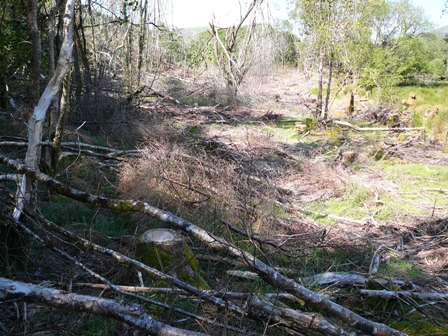
In this extraordinary photograph, the buffer zone of broadleaves planted to protect the site has been felled during site 'restoration' after the clearfelling. This destroyed its value as a stable buffer zone for the site and raises questions about the reality of the broadleaf element in the national planting targets if this is their fate. Gour, Castletownbere. |
|
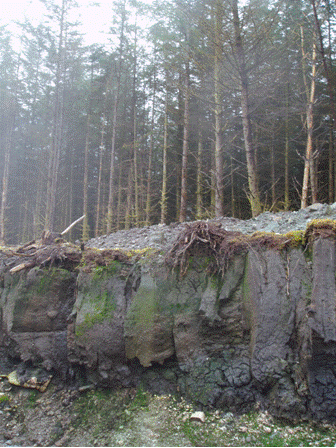
The construction of a forest road above Sneem in County Kerry reveals the depth of peat in these mountains. Acid soils render phosphorous insoluble and so unavilable to plants. Stressed trees withdraw phosphorous from their needles. As only foliar tests not soil samples are used to check phosphorous levels, more phosphates are applied, adding to the 'phosphorous time bomb' that is triggered by clearfelling. |
|
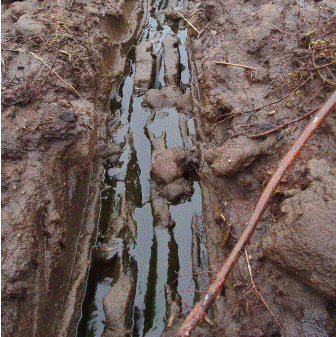
Planting on peat soils destroys the natural carbon sink, releasing greenhouses gases. The Soil Associations Woodmark, whose audit of Coillte Teo for the Forest Stewardship Council [FSC] led to this year's renewal of Coillte's FSC certification until 2011, refused to consider the carbon cycle implications of planting on peat soils as being 'beyond the scope of an FSC audit. The definition of peat soils used by the Forest Service is based on the depth of peat. The definition of peat soils used under the Nitrates Regulations depends on the percentage of organic matter. Both come under the same Minister for Agriculture. The European Environmental Bureaus land cover analysis has determined that 84% of Ireland's forestry planting was on peat soils. Ireland denies this, suggesting 35%. The definition of peat soils explains the difference. Sneem. Co. Kerry. |
|
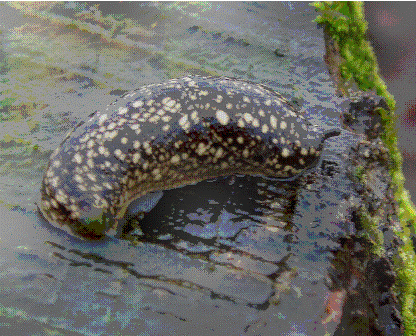
The protected Kerry Slug. Pesticide signs had been erected warning the public not to gather fruit, berries, or mushrooms. This pesticide, applied in July of 2004 and May of 2005 against the pine weavil, would be fatal to the slug. Coillte stated that 'in their consultation with the NPWS the issue of Kerry slug did not arrise'. The Red Data Book states that the Three-lobed Crowfoot Ranunculus tripartitus is present at five sites in Ireland. While the book states that Two of the Kerry sites are in small streams near Sneem and are still extant the local Parks and Wildlife Ranger told FIE's Inspector that he did not know these locations and was therefore unable to say if the forestry was impacting on it. |
|
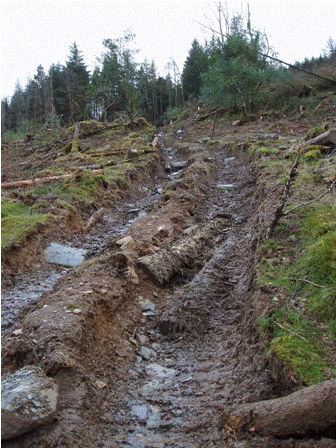
This is the reality - no brash mats. Coillte wrote to us of this site 'There is clear evidence of brash mats being used on all extraction racks and on the main track.' Yet this photograph shows the effects of heavy machinery operating with total disregard for the Forest Service Guidelines. These Guidelines state clearly that 'On sites where risk of erosion is high, brash mats must always be used to avoid soil damage, erosion, and sedimentation'. The 'Environmental Impact Assessment' checklist for this site - and Gour - gave a 'medium' possibility of damage from 'possible rutting' with the mitigation as 'adhere to Guidelines'. Rosnacroo, Co. Kerry. |
|
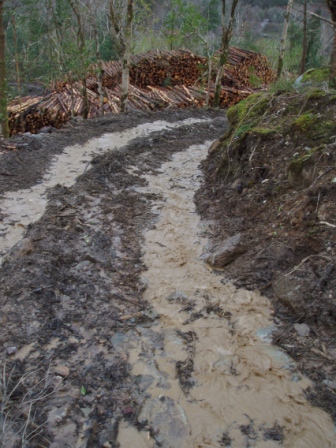
The main site road acts as a river in this photograph, flooding nutient laden sediment down the hillside past the stacked timber. Rosnacroo, County Kerry. Coillte responded to our complaint by saying 'There were no silt traps on site during harvesting as there were no drainage channels or streams on site.' |
|
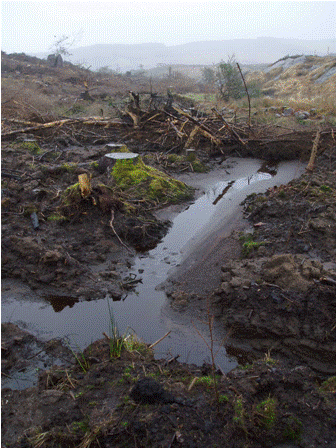
In this photograph, the silt can be seen accumulating and flowing through a drain across what should be a 15 to 25 metre buffer zone. It exits the site under a build up of brash into a watercourse. Decaying brash in itself contributes to the nutrient and silt load. There were no buffer zones or silt traps on this site as required by the Forest Service Guidelines, which state Sediment traps must be clearly marked and securely fenced for safety. The site drains into the water supply for Sneem, County Kerry. |
|
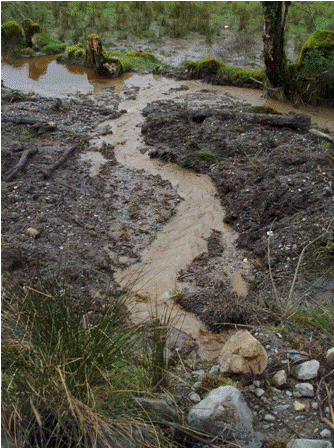
As the road reaches the valley bottom at Rosnacroo, the sediment laden waters cut their way out of the site. Exposed clay-based sub-soils contain phosphorous. The Guidelines state that 'subsoils may be more prone to erosion than associatiated topsoils.' When eroded, transported nutrients may encourage algae blooms and their negative environmental consequences. A silt trap was installed here - after the felling was completed. |
|
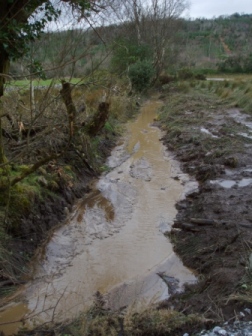
Finally, the sediment laden water flows along this drainage channel across the neighbouring field and into the Loo River, a river designated 'sensitive'. In not one of these sites did the Forest Service, The Parks and Wildlife Service, the Fisheries Board, the Local Authority, Coillte Teo, or the FSC Auditors suggest that any Guidelines had been violated or that there was anything wrong with the forestry practices used. Yet the survey we undertook demonstrated that there is a consistent disregard of the Forest Service Guidelines, FSC Principles and European Law. ENDS |

All logos and trademarks in this site are property of their respective owner.
The comments are property of their posters, all the rest ©
Legal Acknowledgement
Hosting by
Created & Designed by